
The Friendly invasion which never left!
The Americans came...and never really returned home!
After the deverstation of Pearl Harbour, the American publics opinion changed and the decades of international non-beligerance changed. The beast was awoken, and the might of the United States began to change the world, firstly as an industrial and technological provider of war machinery and weapons but also through their foreign policy which was extended across the world through a series of overseas military bases and establishments. Great Britain was the first nation to feel the effect of this surge of U. S personnel and military bases. Back in the 1940’s, the mass of ‘Boots upon the ground’ was known as the friendly invasion. Its effect upon the British people was profound and relationships which developed, still bear weight today. At the end of the war a mass exodus was felt, with thousands of Men and Women sailing back across the Atlantic, Britain became much quieter… however after 81 years did the ‘Friendly Invasion’ really leave Britain?
Private Milburn Henke, from Hutchinson, Minnesota, of the 133rd Infantry Regiment, US Army’s 34th Infantry Division, known as the “Red Bull” Division, smiled and waved at a photographer as he walked down the gangplank upon the Quayside of a wet and dreary Belfast dock side. For he was just the first of 4’058 combat soldiers which had embarked two troops ships and sailed for a week across the Atlantic from Brooklyn, New York to Northern Ireland as part of a war time convoy, A-10.
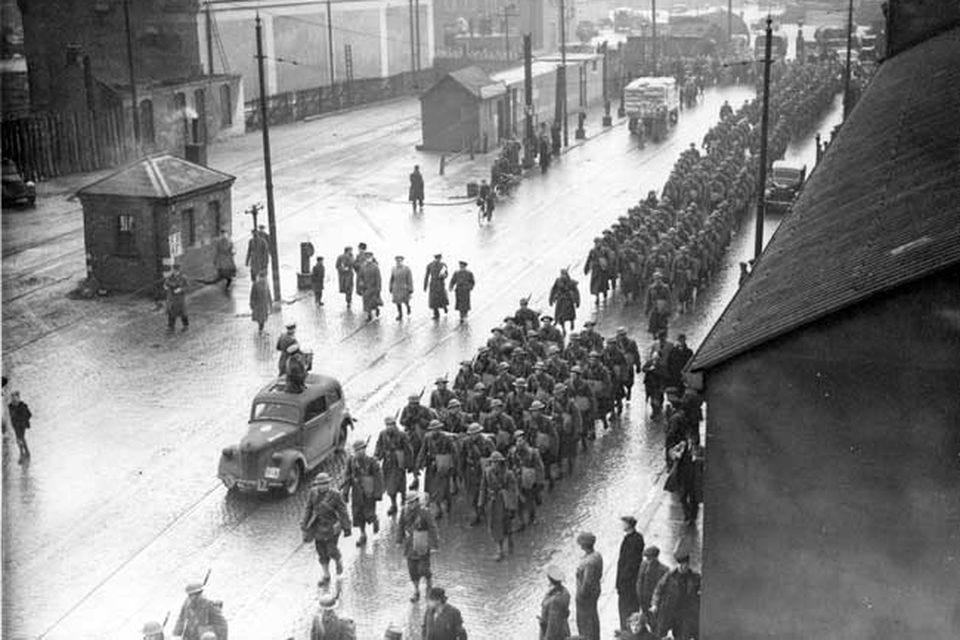
A Belfast Silver band welcomed the troops as they disembarked, playing “Marching through Georgia,” and the crowd of onlookers cheered as the United States now contributed to the British war effort which had been at war for two years already. For the British people were now in the depths of war time rationing, meaning food, clothing and luxuries were hard to come by. The Americans, were seen by definition as polar opposites with money, food and luxuries which immediately endeared them to the local women. The War Department had for-seen a possible clash of cultures as many of the servicemen had never been abroad before. They tried to mitigate any problems by issuing all personnel an orientation pamphlet, called “The Pocket Guide to Northern Ireland,” to familirise them with the country, its weather, dress, customs and culture. It urged all personnel to remember “Every American Soldier is an unofficial ambassador of goodwill.” Despite a large number of Americans having British and Irish heritage, they were warned about religious and political differences between Northern and Southern Ireland, and strongly reconmended that personnel should “avoid arguing religion or politics” which was described as a national sport in Britain. [ This, they got wrong, as moaning about the weather is the British national sport!]
As the troops began to settle in the UK, the War Department developed a further pamphlet entitled “American Servicemen in Britain.” This was designed to familiarise servicemen with their life in the other parts of Britain in assisting with some of the unique history, culture, and even the slang, which was believed to possibly cause offence if it was not understood. The pamphlet advised;
“The British don’t know how to make a good cup of coffee. You don’t know how to make a good cup of tea. It’s an even swap.”
It even went as far as to advise, “NEVER criticize the King or Queen.” But what the British people did not know, was that the United States had been well aware of what was going on in Britain since 1939, as they had secretly prepositioned a military diplomatic mission to the U.K upon the eve of war. This mission was called the Special Observers ( or SP.OBS) had secretly watched and gauged the British response to the Nazi war machine rolling across Europe and threaten to invade the British Isles. Headed by General Raymond E. Lee, who had been promoted to Military Attache of the U.S Embasy in London in 1936, he within a few years become a very well respected man and was allowed to move unrestricted within British government circles. In fact British Military Intelligence Officer, Major General Sir Frederick Beaumont-Nesbitt, considered Lee a “Trusted Friend” and described him as a ‘Trusted Professional Soldier.’ General Lee was replaced by Major General James E. Chaney in 1940 who headed the SP.OBS mission till 1942. He alike his predessessor built a good working relationship with his British counterparts, and supported the British war effort and even went as far as reporting back to Washington that in his view, the British were capable of fighting the Germans although, the war was likely to be protracted as British industrial capacity alone would not be enough to defeat the Germans quickly. Chaney would be promoted to Theatre commander in 1942 and his work alongside the other Special Observers prior to that, would be to make preperations for any American involvement in the war in Britain.
As part of the action plan, the Special Observers alongside their British counterparts looked at possible sites which would be suitable for an American air combat force to establish itself in the United Kingdom. Sites across all 4 nations were surveyed and what resulted, was a carefully chosen group of aerodromes in the Cambridgshire/Northamptonshire area, some of which had just been completed for the Royal Air Force, but would now be handed over to the U.S Army Air Forces. Aerodromes at Grafton Underwood, Polebrook, Molesworth, Chelveston, Poddington, Thurleigh and Alconbury were all selected. These aerodromes would become home to the first Bombardment group of the U.S Eighth Air Forces, and eventually the first of three bombardment divisions by the end of the war. Other aerodromes were identified for training purposes such as Goxhill, in Lincolnshire as well as two huge sites suitable to become sprawling engineering depots. One at Burtonwood, near Warrington in Cheshire and Langton Lodge on the shores of Lough Neagh, not far from Belfast in Northern Ireland. Headquarters and administrative centres were established at Brampton, Membury, Greenham Common and Bushy Park in London as well as in a former Girls private School at Daws Hill which was situated across the road from the Royal Air Force headquarters at High Wycombe. This would be code named PINETREE.
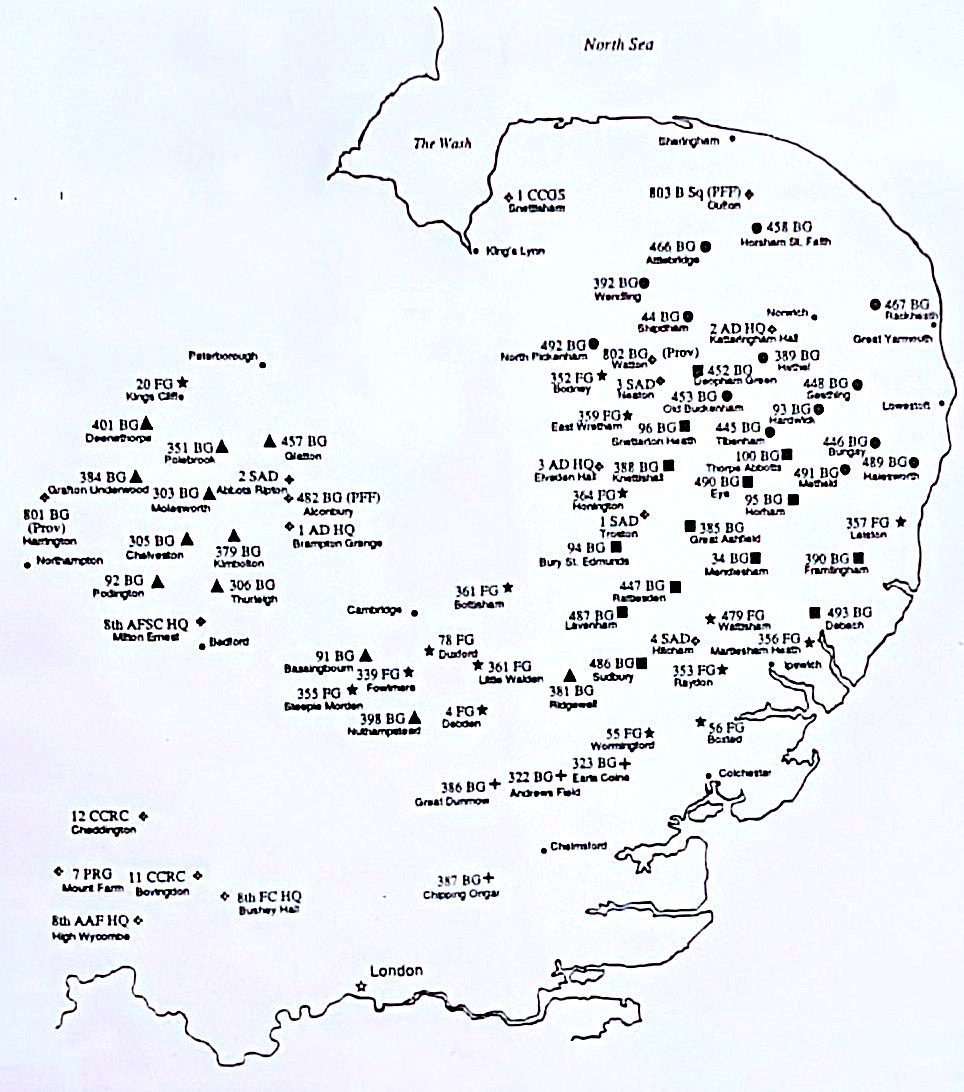
Over the next 18 months the build up of U.S Army Air Forces would be gather pace and the Eastern region of England would become home to both the U.S 9th Army Air Force and the second and third divisions of the aformentioned Eighth Air Force. By the beginning of 1944, much of the airspace above the Eastern part of England was choked by the volume of American and Royal Air Force aerodromes and aircraft flying within it. This plays part to the region of East Anglia known for its “Big Skies.” With the build up of men and materiel continuing for the invasion of Europe, England in the Spring of 1944 became jokingly known by British locals as “Little America” due to the shear amount of temporary tented encampments and depots seemingly springing up overnight ready for the big show to start. Post D-Day, as units left to deploy to France and then other parts of Europe, Southern England which had been awash of trucks, armoured vehicles and camps now became subdued. And then as the end of the war came and the floors of the V.E day parties had been swept, the Americans left as quickly as they came. Troop ships left Liverpool for New York grossly overflowing with home sick Soldiers, Doctors and Nurses, Administration Clerks, Truck Drivers, cooks, Engineers and Ordnance men and American Red Cross volunteers.
And onto the Cold War era. Despite the official end to the ‘Friendly Invasion’ the U.S forces and especially the U.S Airforce maintained a strong presence within Britain and across Europe. PINETREE/ High Wycombe became vacant as the Headquarters of the Third Air Division moved to South Ruislip on 15 April 1949, and then was re-occupied by the 7th Air Division with the 3929th Air Base Squadron taking the site over during May 1952. In 1961 two 210 room dormatories were contructed upon the 67 acre site and the 322nd Air Division (MAC) relocated from Chateauroux AB, France and became operational on 5 August 1966. The site closed in 1971.
Headquarters of the Third Air Division moved to South Ruislip on 15 April 1949, and the military base established the 7th Air Division as part of S.A.C Command in U.K on 20 March 1951. As part of the S.A.C Command in the U.K, the 7500th Air Base Group re-organised and re-assigned newly designated squadrons at South Ruislip, Northolt, Bovingdon, Bushy Park and Chicksands in May 1951. The West Ruislip base was assigned to Third Air Force on 1 December 1955 and remained until 1972 when it moved to RAF Mildenhall. Ruislip is under renovation and is due to become home to a joint US Army, Navy Air Force and private contrator administration base.
In response to what was perceived as a growing worldwide threat, S.A.C Command decided to maintain a strong force of U.S Airforce bombers in England. Four airfields in and around Oxfordshire were upgraded to serve this purpose. Upper Heyford was one of those selected, the others being at Brize Norton, RAF Fairford and RAF Greenham Common. KC-50 tanker operations began at Heyford in December 1951 and B/RB-36 bomber rotations began the following year and this was followed by B-47 rotations between 1953 and 1965. S.A.C operations finally ended in January 1965. The station then was put upon care and maitenance status until September 1st, 1966 until the arrival of the 66th Tactical Reconnaissance Wing (TRW) from Laon in France, which provided support for the 20th Tactical Fighter Wing (TFW) after its arrival from RAF Wethersfield on 1 April 1970. Upper Heyford Closed for flying in 1994 when it reverted to Ministry of Defence ownership. Its currently being developed as a housing estate.
RAF Wethersfield was assigned to Third Air Force on 24 August 1951, and welcomed the arrival of 20th Fighter-Bomber Wing on June 6, 1951. The 20th FBW joined the 49th Air Division which consisted of 47th Bombardment Wing which provided a nuclear capability. These units stayed until the sation was closed for flying. The base was managed by the 20th Combat Support Group on 26 January 1956 and remained until the base closed.
RAF Molesworth, one of the original WW2 airfields handed to the USAAF, was assigned to the Third Air Force during July 1951, and was immediatly upgraded with a new runway and control tower built. In February 1954, the 582nd Air Re-Supply Group (ARG) arrived with Boeing B-29’s, for rescuing aircrews brought down over enemy territory. In the spring of 1957 Molesworth became a USAF family housing annexe and a supply/spare parts storage depot for Alconbury. On the 5th July 1966, the station became designated as a storage site. The airfield was closed to flying in 1973 and its runways, hardstands and allmost all the existing World War two era buildings were demolished during 1980’s.
Another former World war two airfield assigned to the U.S Airforce was RAF Sculthorpe which was re-built between 1944 and 1948 as one of three RAF Very Heavy Bomber airfields. On the 17 January 1949, the S.A.C heavy bomber wings began a period of three month rotational duties from the USA beginning on the 7th of February 1949, and ending October 1950. On the 5th June 1952, the 1st Tactical Support Squadron was assigned to Third Air Force and for the next nine years the station housed the 49th Tactical Air Division flying with North American B-45 Tornado’s followed by Douglas B-66 Destroyer bombers. The 420th Refuelling Squadron with KB-50 tanker aircraft operated from Sculthorpe from 4th October 1955 to the 25th May 1964. On the 22nd June 1962, the 47th Bombardment Wing deactivated and Sculthorpe was handed over back to the RAF on the 30 June. In 1992 it was handed over to the Air Ministry. The airfield is now a MoD training facility.
The infamous Greenham Common was confirmed as the fourth of the S.A.C bomber bases. The station underwent major overhaul ready for the first SAC B-47 unit which arrived early in 1954, but was immediately transferred to Fairford because of the poor runway construction. The runway was reinforced between 1954-1956 and the base was then deemed suitable as a deployment base for KC-97G tankers which operated between 1956 and 1964. S.A.C deactivated the base and the station was transferred back to RAF control on 30 June 1964. The airfield has been returned to public ownership and is curently public parkland. Some parts of the former airfield are still within use as film sets for TV and movies.
Bushey Park, one of the original USAAF administrative establishments welcomed the The Third Air Division HQ on 8th September 1948 but this unit moved to South Ruislip in April 1949. Other units which operated from Bushey Park over the next few years were the 1813th Airways and Communication Service Group and the 28th Weather Squadron. After the the London Area Consolidation Plan, Bushy Park was vacated on 29 October 1962 and handed over to the British Ministry of Works.
Burtonwood or Base Air Depot 1 (BAD1) was the largest military airfield in Europe during WW2, home to 18’000 American personnel. It remained under U.S. control to support U.S. bases in the U.K and to undertake all major aircraft servicing a simular role to which it performed during the war. The 59th Air Depot Wing arrived in September 1948 and was given Berlin Airlift maintenance work. On the 1st March 1954, the station transferred from Third Air Force to Air Materiel Forces, Europe. On the 1st July a new Air Passenger Terminal opened as part of a major reconstruction project which included a large Header House, an extension to the runway extending it to 9’000 ft and the building of the new control tower. Two years later the base passed back to RAF control and two years later the US Army took control of the site. The base officially closed in 1991 and since then the runway and most of the associated buildings have been demolished.
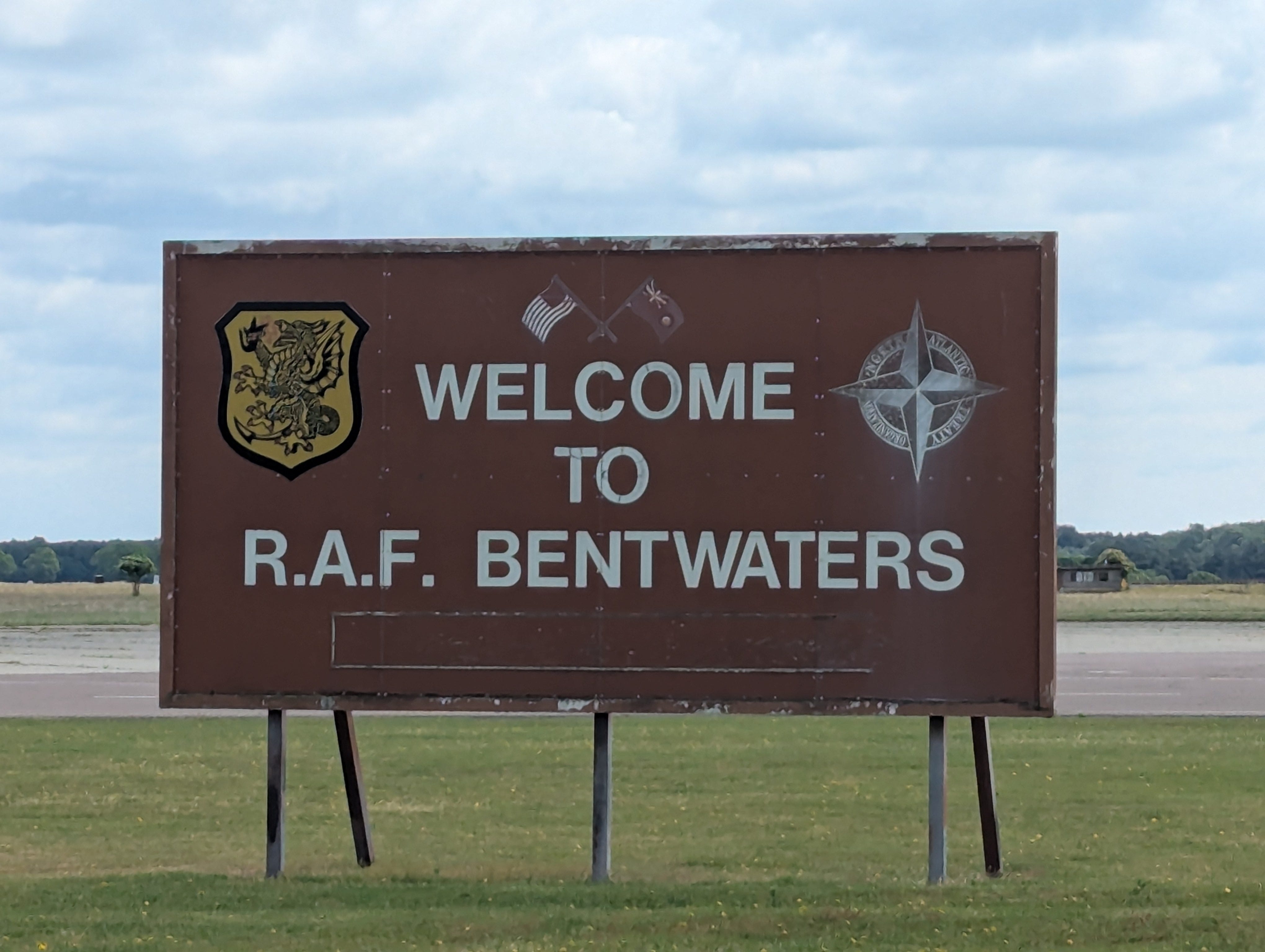
RAF Bentwaters base origin dates to 1942 when construction began on a Royal Air Force Station called RAF Butley for use by Bomber command. It was opened for operational use in April 1944 and became home to multiple RAF and USAAF fighter squadrons rotating through the station. Control of Bentwaters was transferred to the U.S. Air Force on 16th March 1951 where the 7506th Air Support Group formed at the base. The 81st Fighter Interceptor Wing assigned to Third Air Force in late 1951 where it co-operated from RAF Shepherds Grove. In early 1965, the 81st FIW began operating the F4-D Phantom until early 1979, when the wing converted to the A-10 Thunderbolt II. For many years the 81st Fighter Wing also operated from RAF Woodbridge just a few miles away, with both Bentwaters and Woodbridge airfields being known as the “Twin Bases”. On the night of 13–14 August 1956, RAF Bentwaters was the location of an night-time radar and visual sighting of multiple UFO’s which had led to decades of public interest and intreague. The last A-10 aircraft departed Bentwaters on the 23rd of March 1993, and the 81st Tactical Fighter Wing was inactivated on 1st July 1993. With the inactivation, the USAF returned control of the base to the Ministry of Defence. The site is now known as Bentwaters Parks. The Bentwaters Cold War Museum is located on the site, many of the former hangars are used as warehouses, and the site is also used for television and film making.
RAF Coughton. Originally constructed in 1938, it became RAF Brackley. In 1941 RAF Croughton was officially odopted. During WW2 it was home to a vast number of Commonweath pilots undertaking training as part of No 16 Operational Convertion Unit along with RAF Upper Heyford. At the end of 1950 when the U.S Air Force took control of the station, the 1969th Communications Squadron based at RAF South Ruislip formed an detachment at RAF Croughton. This began RAF Croughton’s new communications mission. Over the next several decades the units stationed at RAF Croughton changed many times, but the operational mission remained communications. It is currently home to the 422nd Air Base Group and operates one of Europe’s largest military switchboards, processing approximately a third of all U.S. military communications in Europe. In August 2019, RAF Croughton made headlines. Harry Dunn, a local teenager was killed when he his motorbike collided with a vehicle driven on the wrong side of the road by Anne Sacoolas, the wife of a U.S Government employee working on the Royal Air Force station. The incident caused outrage when it was discovered that Sacoolas had been returned to the U.S so she could not stand trial within the U.K.
RAF Chicksands was designated as a secondary installation (sub-base) on 8 November 1950. USAF reconstruction commenced in 1951 for 10th Radio Squadron (Mobile). The base hosted units of Third Air Force and Field No.2 of the National Security Agency from 1951 to 1958 before passing to Electronic Security Command on 1 July 1958. It was handed back to the RAF in 1996 and is known today as MOD Chicksands home of the British Army inteligence Corps.
RAF Mildenhall. This former WW2 RAF bomber command station was handed over to USAF control in 1950. On the 16th May 1951, the station transferred to S.A.C. From 1953 to 1958, Boeing B-47 bombers and KC-97 tankers operated from Mildenhall. After the closure of the Burtonwood Depot, the Military Transport Service was transferred to Mildenhall on 1 March 1959 and Mildenhall became “The Gateway to the UK” for American personnel. On 1st July 1966 the European Command (USEUCOM) moved its Airborne Command Post from France to Mildenhall. During 1970 a combat operations centre was completed as part of an extensive redevelopment. The Third Air Force HQ transferred from South Ruislip in June 1972. Further development was undertaken throughout the late 1970s. The 100th ARW moved to the base in 1992 becoming Headquarters European Tanker Task Force with its KC-135 Stratotankers. During the 2003 invasion of Iraq, the 491st Air Expeditionary Group (491st AEG), the 491st Air Expeditionary Aeromedical Evacuation Squadron and the 744th Expeditionary Airlift Squadron all operated from Mildenhall. In 2021, the POTUS Joe Biden flew into Mildenhall for the 47th G7 Summit where he briefly addressed the bases personnell after landing. The base also supported the POTUS visit to Ireland and Northern Ireland in 2003. The base remains a vital facility to U.S Forces in Europe.
RAF Lakenheath. Currently the largest US base in the U.K. Originally opened during the first world war, and then used a satalite airfield to Feltwell and Mildenhall from 1941. Lakenheath was handed to the USAFE along with Scampton, Waddington and Marham for use by S.A.C as a short-term deployment base in July 1948. Boeing B-29 Superfortresses of 2nd Bomb Group arrived 11 August 1948, and this continued a pattern of rotational groups through Lakenheath until 1959. The 48th Tactical Fighter Wing on 15 January 1960 after transfering from France and the base had to undergo a extensive redevelopment to accomodate its personnel. Between 1961 and 1962 a large base hospital was constructed which became the primary hospital for U.S armed forces in the U.K. During the 1070’s more construction work was undertook with Hardened Air Shelters and further accomodation as the 48th TFW flew General Dynamics F-111 strike aircraft. Lakenheath received its first McDonnell Douglas F-15 E Strike Eagles in 1992. In January 2015, the Department of Defence announced that Lakenheath would become home to two squadrons of F-35 Lightning Stealth fighters. To accomodate one of the most advanced aircraft in the world further engineering sheds were built part of an $118.4 million investment. Lakenheath remains a vital part of U.S operations within Europe.
RAF Feltwell. Originally a RAF Bomber command station during WW2, Feltwell became home to RAF Thor missiles between 1958 and 1963. The first U.S AF units were the 5th Space surveillance Squadron in 1989. With extensive communications and electronic equipment on site Feltwell became home to the 5th SPSS was part of the USAF's Passive Space Surveillance Network which tracked the physical location of emitting satellites in orbit. It was inactivated in 2003 and the activity transferred to Misawa Air Base in Japan where Feltwell became an accomodation facility for the nearby air bases of Lakenheath and Mildenhall.
RAF Menwith Hill, and Fylingdales. Menwith Hill was established in 1954 as an intelligence support service and communication intercept station. The base is used by personnel from the US National Security Agency (NSA) and the UK Government Communications Headquarters (GCHQ) under the 1951 NATO Status of Forces Agreement. RAF Menwith Hill has been described as the largest electronic monitoring station in the world. RAF Flyingdales is easily recognisable from its huge AN/FPS-132 Phased Array static array radar located atop of Snod Hill, in North Yorkshire and was part of the Cold war 4 minute warning. Its current role is as part of United States Space Surveillance network. Both facilities remain operational.
RAF Welford. This base is currently home to the 501st Combat support wing which provided support to all U.S units within the U.K. and is a storage site for munitions.
RAF Fairford. Constructed in 1943 to support U.S and British troop transport operations for the invasion of Europe, in 1950 a 10’000 ft (3,000 m) runway was constructed for long-range bomber operations and completed in 1953. The length of the runway allowed Fairford to become a forward operating base for very heavey bombers and transport aircraft, In the 2003 Iraq war, B-52s flew from Fairford as part of Operation Iraqi Freedom. In recent years the airfield has been occasionally used by American B-2 Spirit stealth bombers and has also been used by U-2 High Altitude Spy aircraft. In September 2010 the U.S AF withdrew all its uniformed staff from the station, leaving a civilian operating unit to maintain the base on a “care and maintenance” basis. However the base remains a designated standby airfield for heavy bomber operations. It is capable of immediate reactivation within 24–48 hours and it continues to host the Royal International Air Tattoo every July.
And so, whilst the Friendly invasion of 1942 was the beginning of the Anglo-American partnership, the end of the second world war was not the end. The relationship with which British and American service personnel have fought, and lived alongside each other for decades have built strong relationships upon a common culture. The United Kingdon still maintains American bases upon its soil, which contribute to not only British defence, but also the defence of Europe, and NATO. Therefore we suggest that the ‘Friendly Invasion’ never left!